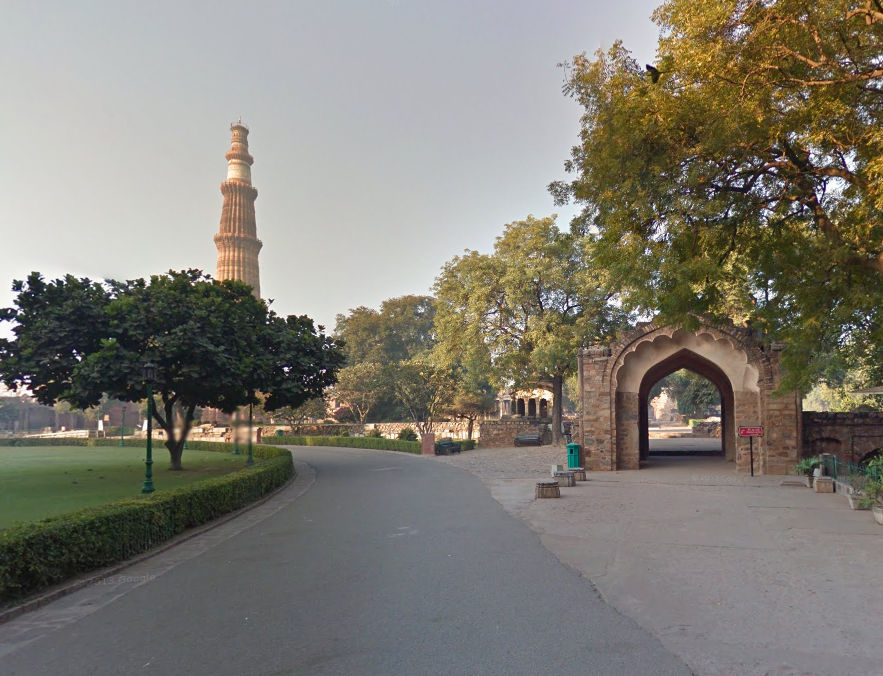
— QUTUB MINAR —
Quick History
The Qutub Minar plays a pivotal role in the story of Delhi's rise as a political and cultural center. While many visitors focus solely on the minaret, the larger Qutub Complex contains a wealth of 11th- and 12th-century monuments that speak of the impact of Delhi’s first Sultanate rulers.
What makes the Qutub Minar an important site?
In Delhi's history, the Qutub Minar marks the arrival of Islamic rulers in the Indian subcontinent and the beginning of Islamic rule.
Until 1192, Delhi was under the control of Prithviraj Chauhan, a Hindu ruler, as the fortified city of "Qila Rai Pithora." The Chauhans, however, governed from Ajmer in Rajasthan.
In 1192, Muhammad of Ghor defeated Chauhan and appointed his general, Qutb-ud-din Aibak, as viceroy. Aibak and his successors established Delhi as a capital city—the first in the succession of eight capitals that Delhi would witness over the next seven centuries.
Who constructed the Qutub Minar and why?
Following the Ghurid conquest in 1192, Aibak began building the Quwwat-ul-Islam Mosque, meaning "Might of Islam," intended as a congregational mosque. This mosque, also referred to as the "Dome of Islam" (some say the original title was "Qubbat," not "Quwwat"), introduced classical Islamic architectural forms to India.
The mosque incorporated elements from existing Hindu and Jain temples, notably carved pillars and cladding, reflecting a fusion of architectural styles. Aibak completed the initial construction, and his successors, Shams ud-Din Iltutmish (1229-1236) and Alauddin Khilji (1296-1316), further expanded the complex. Drawing inspiration from his Ghurid heritage, Aibak added a minaret, the Qutub Minar, at the southeastern corner of the mosque in 1199.
Why is it called the Qutub Minar?
"Qutub" translates to "axis" or "pole," but the name's exact origin remains uncertain. It's believed to be named either after Qutb-ud-din Aibak himself or Khwaja Qutbuddin Bakhtiyar Kaki, a revered 13th-century Sufi saint.
How tall is the Qutub Minar, and what is it made of?
Constructed from red and buff sandstone and intricately carved with inscriptional bands, the Qutub Minar stands as India's tallest brick-masonry tower, reaching 72.5 meters. The tower comprises five stories, with the fifth story redeveloped later by the Tughlaqs in the 15th century.
More in the Qutub Minar series