Quick Summary A stone masonry astronomical observatory commissioned by Sawai Jai Singh II, the founder of Jaipur. It is the largest of the five observatories built across Northern India and houses the world's largest sundial.
Quick Facts at a Glance
Location | Near City Palace, Jaipur |
Opening Hours | 9:00 AM - 6:30 PM |
Entry Fee | Adults—₹100 (Indians) / ₹600 (foreigners)—See ticket guide |
Time Needed | 1 - 2 hours |
Best Time to Visit | October to March (Winter), Early morning |
Photography | Allowed (no professional equipment) |
Accessibility | Wheelchair accessible |
Self-Guided Exploration
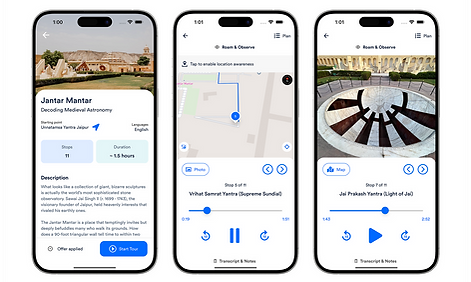
You can get a step-by-step explanation and GPS-guided tour of Jantar Mantar with the Tourismo app.
The tour comes with:
10+ connected narratives covering all instruments, their operations and even their flaws
The back story of Jai Singh's obsession with astronomy and how the observatory got commissioned
Celestial coordinate systems and astronomy basics
Optimal route to experience the full site without missing out
Offline access; no internet needed
Table of Contents
Overview & History
At the heart of Jaipur stands Jantar Mantar, one of the most fascinating astronomical observatories ever built. Constructed in the 18th century by Maharaja Sawai Jai Singh II (r. 1699–1743), this remarkable site transforms stone and marble into precision instruments capable of measuring time, tracking celestial bodies, and predicting astronomical events with extraordinary accuracy.
Constructed over 10 years (1724–1734), these observatories served three vital pillars of knowledge at that time.
First, they enabled the precise measurement of local time
Second, they helped estimate the coming of seasons and aided the creation of an accurate calendar for farming and tax collection
Third, they corresponded to astrological calculations that governed every major decision from royal weddings to declarations of war

City Palace & Jantar Mantar The observatory stands just across the road from the City Palace complex. Its relatively low elevation limits observations of stars near the horizon, and the surrounding market area creates light pollution that makes night-time observations difficult.
How to Reach Jantar Mantar
By Car/Taxi
From Jaipur International Airport: 14 km, 25-30 minutes via Tonk Road
Pre-paid taxi: ₹400-500
Uber/Ola: ₹300-400
From Jaipur Railway Station (Junction): 5 km, 15-20 minutes via Station Road/MI Road
Auto-rickshaw: ₹100-150
Uber/Ola: ₹120-180
Metro: Pink Line to Badi Chaupar (₹20-30)
From Amber Fort: 11 km, 25-30 minutes via Amer Road
Parking: Available at Gate No. 2 near Jaleb Chowk (₹50-100 for 2-3 hours). Limited space—arrive early!
By Metro
Nearest Station: Badi Chaupar Metro Station (Pink Line)
Distance from station: 800 meters, 10-minute walk through bazaar
Directions: Exit metro, walk through Tripolia Bazaar toward the palace
💡 Pro Tip The observatory is in the bustling old city with narrow streets and heavy traffic, especially 11 AM - 5 PM. If driving yourself, arrive by 9 AM for easier parking. Better yet, take an auto-rickshaw or metro. Combine your visit with nearby City Palace (2-minute walk) and Hawa Mahal (7-minute walk) for the perfect morning itinerary.
Entry Fee and Tickets
→ See our page on Jantar Mantar tickets
Online Booking
Tickets can be booked through the official OBMS portal
What to See Inside Jantar Mantar
The observatory houses 15+ instruments but not all are unique in purpose; some are smaller prototypes of the larger instruments.
🎧 Follow Tourismo Audio Guide Route The Tourismo audio guide takes you through these highlights in the perfect sequence revealing operation, measurement, and utility.
Ram Yantra
Named after Lord Rama, this instrument helps find precise altitude-azimuth of the sun

Vrihat Samrat Yantra
World's largest stone sundial

Nadivalaya Yantra
Equatorial "twin" sundials

Other Notable Features
Unnatamsha: For simple and precise altitude calculation
Digamsha: For simple and precise azimuth calculation
Jai Prakash Yantra
Kapali and Chakra Yantras
Get the Complete Experience with Tourismo
The Tourismo audio guide covers all parts of Jantar Mantar in detail with:
20+ minutes of expert narration covering every instrument and operating principle
Story of founding of the 5 observatories
The reason behind certain design decisions of the observatory
Flaws, shortcomings and conservation of the site
Practical Visitor Tips
✅ What to Carry | ❌ What NOT to Carry |
|---|---|
Valid photo ID (mandatory for foreigners) and e-ticket, if booked (see our guide) | Large backpacks or luggage |
Water bottle, sunscreen, hat, and sunglasses | Food and drinks (not permitted inside) |
Comfortable walking shoes | Tripods and professional camera equipment (prohibited without special permission) |
Phone/camera fully charged | Drones (prohibited) |
♿ Accessibility | 🚰 Facilities |
|---|---|
Wheelchair access: The site is level except the platforms of Jai Prakash and Kapali instruments | Restrooms: Well-maintained, clearly marked with signage |
Mobile network: gets good coverage (Airtel, Jio, Vodafone) | Food/Cafeteria: A vendor shop serves refreshments, tea, coffee, cookies |
Guided Tours
Official guides: Available for hire at entrance (₹300-500 for 1-2 hours)
Audio guides: Download Tourismo's professionally curated tour → Audio Guide
How Long You'll Need
Quick visit: 45 minutes
Standard visit: 1-1.5 hours
Nearby Attractions & Itinerary Ideas
Within Walking Distance (<10 mins)
City Palace—the royal residence with exquisite architecture and memorable courtyards
Hawa Mahal—the famed "wind palace"
Pink City Market