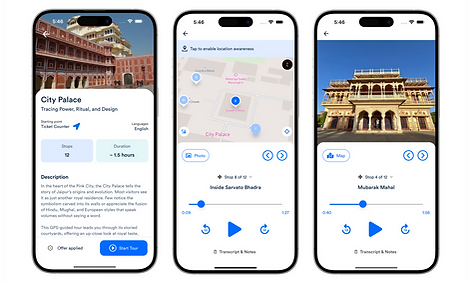
Quick Summary A living royal residence, the City Palace Jaipur is a mesmerizing blend of Rajput, Mughal, and European architecture and history-ridden galleries spanning many interconnected courtyards.
Quick Facts at a Glance
Location | Gangori bazaar, heart of Pink City |
Opening Hours | 9:30 AM - 6:30 PM |
Entry Fee | Adults - ₹310 (Indians) / ₹1010 (Foreigners)—See ticket guide |
Time Needed | 2-3 hours (Standard) / 3-4 hours (With Royal tour) |
Best Time to Visit | October to March (Winter), Early morning 9:30-11 AM |
Photography | Allowed (with restrictions in some galleries) |
Accessibility | Partial |
Self Guided Exploration
You can get step-by-step explanation and GPS-guided tour of the City Palace with the Tourismo app.
The tour comes with:
10+ connected stories covering all courtyards, palaces, museums, and the famous Four Season Gates
The fascinating blend of Rajput, Mughal, and European architecture explained
Stories of Maharaja Sawai Jai Singh II, the royal family, and Jaipur's Pink City transformation
Optimal route to experience the galleries, gateways, and chambers
Offline access—no internet needed
Table of Contents
Overview & History
City Palace Jaipur stands as an ode to royal grandeur in the heart of India's Pink City. Unlike typical forts built for defense, this expansive complex was designed as both a royal residence and administrative center. It's a living palace where the royal family still resides today.
Covering one-seventh of the walled city of Jaipur, the palace complex is an extensive network of courtyards, gardens, buildings, temples, and museums. Built between 1729-1732 by Maharaja Sawai Jai Singh II (the visionary founder of Jaipur), the palace represents a revolutionary urban planning achievement. Jai Singh shifted his capital from Amber (11 km away) to Jaipur due to increasing population and water scarcity, commissioning two brilliant architects to design both the city and palace.

The architectural genius behind this masterpiece was Vidyadhar Bhattacharya, a Bengali architect who initially served as an accounts clerk before being promoted to Chief Architect. Later, British engineer Sir Samuel Swinton Jacob added 19th-century European elements. The result is an extraordinary fusion of Rajasthani Rajput, Mughal Islamic, and European architectural styles, all designed according to the traditional Indian science of architecture called Vastu Shastra.
The palace seamlessly blends red and pink sandstone with white marble, featuring ornate gateways, intricate mirror work, delicate frescoes, jali (lattice) screens, painted doorways, and some of the finest examples of decorative arts in India.

Key historical insights
1727: Maharaja Sawai Jai Singh II shifts capital from Amber to newly planned Jaipur city
1729-1732: Construction of City Palace complex completed according to Vastu Shastra principles
1876: Entire city including palace painted pink to welcome Prince of Wales (later King Edward VII), earning Jaipur its "Pink City" nickname
1902: Maharaja Madho Singh II travels to England for King Edward VII's coronation with giant silver vessels
1949: Jaipur kingdom merges with Indian Union; palace becomes museum while royal family continues residence
Present: Royal descendants still live in Chandra Mahal; palace functions as museum and cultural heritage site
💡The pink terracotta color you see today isn't the original shade. It was painted in 1876 specifically to honor Prince Edward's visit. The tradition has continued, with a government ordinance requiring all buildings in the old city to maintain the pink color scheme.
Is City Palace Jaipur Worth Visiting?
Absolutely. It's Jaipur's crown jewel and one of Rajasthan's most iconic attractions.
Here's why it's an essential stop on any Jaipur itinerary:
Living Royal Heritage: One of the few Indian palaces still inhabited by descendants of the original royal family
Architectural Marvel: Witness the perfect fusion of Rajput, Mughal, and European styles with intricate mirror work, frescoes, and jali screens that showcase centuries of artistic excellence
Guinness World Record: Home to the world's largest sterling silver vessels (Gangajalis)—weighing 340 kg each and holding 4,000 liters of holy Ganges water
Instagram Paradise: The globally famous Pritam Niwas Chowk with its four rainbow-colored seasonal gates is one of India's most photographed spots
Cultural Immersion: Museums house priceless royal costumes (including 250kg garments of Maharaja Madho Singh I), ancient weapons, rare manuscripts, and stunning textiles
Panoramic Views: The Chandra Mahal offers breathtaking views over the Pink City (with Royal Tour)
Best For:
History & architecture enthusiasts
Photography lovers (especially Instagram and TikTok content creators)
Culture and art aficionados
Families (kids may enjoy the galleries)
Not ideal for: Those with less than 1.5 hours in Jaipur (you'll feel rushed), or visitors unable to climb stairs who don't book wheelchair/golf cart services
How to Reach City Palace
Full Address: Jaleb Chowk, Near Jantar Mantar, Tripolia Bazar, J.D.A. Market, Pink City, Jaipur, Rajasthan, 302002, India
Landmark Reference: Adjacent to Jantar Mantar (UNESCO World Heritage astronomical observatory), in the heart of Jaipur's walled Pink City
By Car/Taxi
From Jaipur International Airport: 14 km, 25-30 minutes via Tonk Road
Pre-paid taxi: ₹400-500
Uber/Ola: ₹300-400
From Jaipur Railway Station (Junction): 5 km, 15-20 minutes via Station Road/MI Road
Auto-rickshaw: ₹100-150
Uber/Ola: ₹120-180
Metro: Pink Line to Badi Chaupar (₹20-30)
From Amber Fort: 11 km, 25-30 minutes via Amer Road
Parking: Available at Gate No. 2 near Jaleb Chowk (₹50-100 for 2-3 hours). Limited space—arrive early!
By Metro
Nearest Station: Badi Chaupar Metro Station (Pink Line)
Distance from station: 800 meters, 10-minute walk through colorful bazaars
Directions: Exit metro, walk through Tripolia Bazaar toward the palace
💡 Pro Tip The palace is in the bustling old city with narrow streets and heavy traffic, especially 11 AM - 5 PM. If driving yourself, arrive by 9 AM for easier parking. Better yet, take an auto-rickshaw or metro. Combine your visit with nearby Jantar Mantar (2-minute walk) and Hawa Mahal (10-minute walk) for the perfect morning itinerary.
Entry Fee and Tickets
→ See our page on City Palace tickets
Entry Gates
Thre are 3 entry gates
Tripolia Gate: reserved for the royal family only
Virendra Pol: Near Jantar Mantar, main entrance for tourists
Udai Pol: Near Jaleb Chowk, alternative entrance near car parking
What's Included in Standard Ticket
Entry to all courtyards (Mubarak Mahal courtyard, Rajendra Pol, Pritam Niwas Chowk)
Access to museums (Textile Gallery, Arms & Armory Gallery, Art Gallery)
Diwan-i-Aam (Sabha Niwas) and Diwan-i-Khas (Sarvato Bhadra)
Ground floor of Chandra Mahal museum
Views of the famous Four Seasons Gates
NOT Included:
Upper floors of Chandra Mahal (requires Royal Tour ticket)
Private royal residence areas
Guided tours (hire separately or use our audio guide)
What to See Inside City Palace
The palace complex follows a logical progression from public spaces to increasingly private royal chambers. Most visitors enter through Virendra Pol, leading to Mubarak Mahal courtyard, then through Rajendra Pol to the spectacular Diwan-i-Khas and Pritam Niwas Chowk, and finally to Chandra Mahal.
🎧 Follow Tourismo Audio Guide Route The Tourismo audio guide takes you through these highlights in the perfect sequence revealing hidden stories, architectural secrets, and the best photo angles at each location.
1. Mubarak Mahal
The "Auspicious Palace", a stunning two-story reception hall that greets visitors in the first courtyard after Virendra Pol entrance. It houses the Textile gallery today.
2. Rajendra Pol
An exquisite marble gateway connecting Mubarak Mahal courtyard to the inner sanctum of Diwan-i-Khas.
3. Diwan-i-Khas (Sarvato Bhadra) - Hall of Private Audience
A unique square, single-story open hall with enclosed rooms at four corners. It's the most important ritual building in the complex, still used for royal celebrations today.
4. Sabha Niwas (Diwan-i-Aam) - Hall of Public Audience
The former public audience hall where Maharajas held court sessions and addressed citizens, now converted into a magnificent art gallery.
5. Pritam Niwas Chowk - The Courtyard of the Beloved
The most Instagram-famous space in India, an inner courtyard with four breathtakingly beautiful gates, each representing a season and dedicated to a Hindu deity.
6. Chandra Mahal
The most iconic building in the complex. A seven-story architectural marvel that remains the residence of Jaipur's royal descendants today.
Other Notable Features
Sileh Khana: Arms and Armoury gallery
Rath Khana: Transport Gallery
Clock Tower: South of Sabha Niwas, installed in 1873 (purchased from Black & Murray Co., Calcutta) to bring Victorian punctuality to court proceedings
Get the Complete Experience with Tourismo
Our audio guide covers all parts of City Palace in detail with:
30+ minutes of expert narration covering every building and gateway
The fascinating story of the Gangajalis' journey to England
Detailed explanation of each seasonal gate's symbolism in Pritam Niwas Chowk
Hidden details about royal family life, festivals, and traditions
Optimal viewing sequence with perfect photo opportunities at each spot
Best Time to Visit City Palace
Best Months
Ideal: October to March (Winter). Pleasant weather (15-25°C), clear blue skies perfect for photography, comfortable for 3-4 hours of walking, peak tourist season but worth it
Good: September & April. Shoulder season, fewer crowds, temperatures 25-32°C, still manageable
Avoid if possible: May to August. Extreme heat (38-45°C) in summer makes palace courtyards unbearably hot, monsoon (July-August) brings heavy rains making marble floors slippery
Best Time of Day
Opening time (9:30 AM): Best choice! Smallest crowds, pleasant morning light for photography, comfortable temperatures, have the Peacock Gate almost to yourself for photos, 2 hours before tour groups arrive
Mid-morning (10:30 AM-12:00 PM): Decent crowds, good natural light in courtyards, temperatures rising
Afternoon (12:00-3:00 PM): Crowded, harsh sunlight, hot (avoid in summer), long queues for popular photo spots
Late afternoon (3:30-5:00 PM): Crowds thinning, softer golden hour light, pleasant temperatures, good for photography
Night visit (7:00-10:00 PM): Illuminated palace, romantic atmosphere, higher ticket price, special ambiance, fewer galleries open
Best Days of the Week
Least crowded: Tuesday, Wednesday, Thursday mornings
Most crowded: Saturday, Sunday, national holidays (especially in winter)
Open: All days
🏆 Top Recommendation: Arrive at 9:30 AM during November-February. Spend 2.5-3 hours exploring at leisure with minimal crowds. You'll have Pritam Niwas Chowk nearly to yourself for uninterrupted photos.
Special Events & Festivals
Jaipur Literature Festival (January): City is packed with visitors, palace busier than usual but electric cultural atmosphere
Holi (March): Colorful spring festival, palace may host special events
Gangaur & Teej (March-April & July-August): Important festivals when Diwan-i-Khas is used for goddess processions
Dussehra (September-October): Royal family celebrations in Diwan-i-Khas, special access sometimes available
Diwali (October-November): Festival of lights, palace beautifully illuminated
Makar Sankranti (January 14): Kite flying festival using 150-year-old royal kites displayed in Diwan-i-Khas
💡Book the Royal Tour ticket (₹4000) if budget allows. It's expensive but the Blue Room and Hall of Mirrors are absolutely worth it, and you get a private guide who shares stories not available on standard tours.
Practical Visitor Tips
✅ What to Carry | ❌ What NOT to Carry |
|---|---|
Valid photo ID (mandatory for foreigners) and e-ticket, if booked (see our guide) | Large backpacks or luggage |
Water bottle, sunscreen, hat, and sunglasses | Food and drinks (not permitted inside) |
Comfortable walking shoes | Tripods and professional camera equipment (prohibited without special permission) |
Phone/camera fully charged | Drones (strictly forbidden) |
Dress Code
No strict dress code, but recommended:
Comfortable shoes
Light, breathable fabrics in summer
Layers in winter
♿ Accessibility | 🚰 Facilities |
|---|---|
Wheelchair access: Available at all major entrances | Restrooms: Multiple locations throughout complex, well-maintained, clearly marked with signage |
Golf carts: Available for hire | Food/Cafeteria: Small cafe serving refreshments, tea, coffee, cookies |
Mobile network: gets good coverage (Airtel, Jio, Vodafone) | Lockers: Not available |
Guided Tours
Official guides: Available for hire at entrance (₹300-500 for 1-2 hours)
Royal Tour guide: Included with the ticket
Audio guides: Download Tourismo's professionally curated tour → Audio Guide
How Long You'll Need
Quick visit: 1 hour (all courtyards)
Standard visit: 1.5 - 2 hours (recommended—courtyards and galleries)
Nearby Attractions & Itinerary Ideas
Within Walking Distance (5-15 mins)
Jantar Mantar — 2-minute walk, UNESCO World Heritage astronomical observatory built by Sawai Jai Singh II, features world's largest stone sundial
Hawa Mahal (Palace of Winds) — 10-minute walk, Jaipur's most iconic pink facade with 953 windows
Tripolia Bazaar — Adjacent, vibrant market for textiles, jewelry, lac bangles, traditional juttis (shoes)
Johari Bazaar — 5-minute walk, famous for silver jewelry, precious stones, Kundan work
In Jaipur (20-40 mins)
Amer Fort — 11 km, massive hilltop fort with mirror palace, elephant rides, UNESCO World Heritage Site
Nahargarh Fort — 12 km, sunset viewpoint overlooking entire Pink City
Jaigarh Fort — 15 km, home to world's largest wheeled cannon
Jal Mahal (Water Palace) — 8 km, stunning palace in middle of Man Sagar Lake
Albert Hall Museum — 3 km, Rajasthan's oldest museum with Indo-Saracenic architecture